

Models of Viewing Disability
Home » Learn » Understanding Disability & Inclusion » Models of Viewing Disability
Understanding the three models of viewing disability will help you to analyse your interventions and build an inclusive environment.
As time has passed, people’s perceptions have changed, and our collective understanding of how to include persons with disabilities has developed. Understanding the three models of viewing disability will help you to analyse your interventions and build an inclusive environment.
Here you will learn about the key elements of each model and their impact on the experiences of people with disabilities. Lets learn together what each model of viewing disability means, and how it impacts the disability community.
What can you find in this section?
You can imagine these three models like three different pairs of glasses with different colored lenses in them. Each color lens will change what you see, and as a result, you may make different decisions based on your picture of what is happening.
The models are called the charity model, the medical model and the social or rights-based model.
The first two models, Charity and Medical approaches – focus on the individual. The third model, the Social model, focuses on barriers in society and society’s view of people with disabilities.
Charity Approach
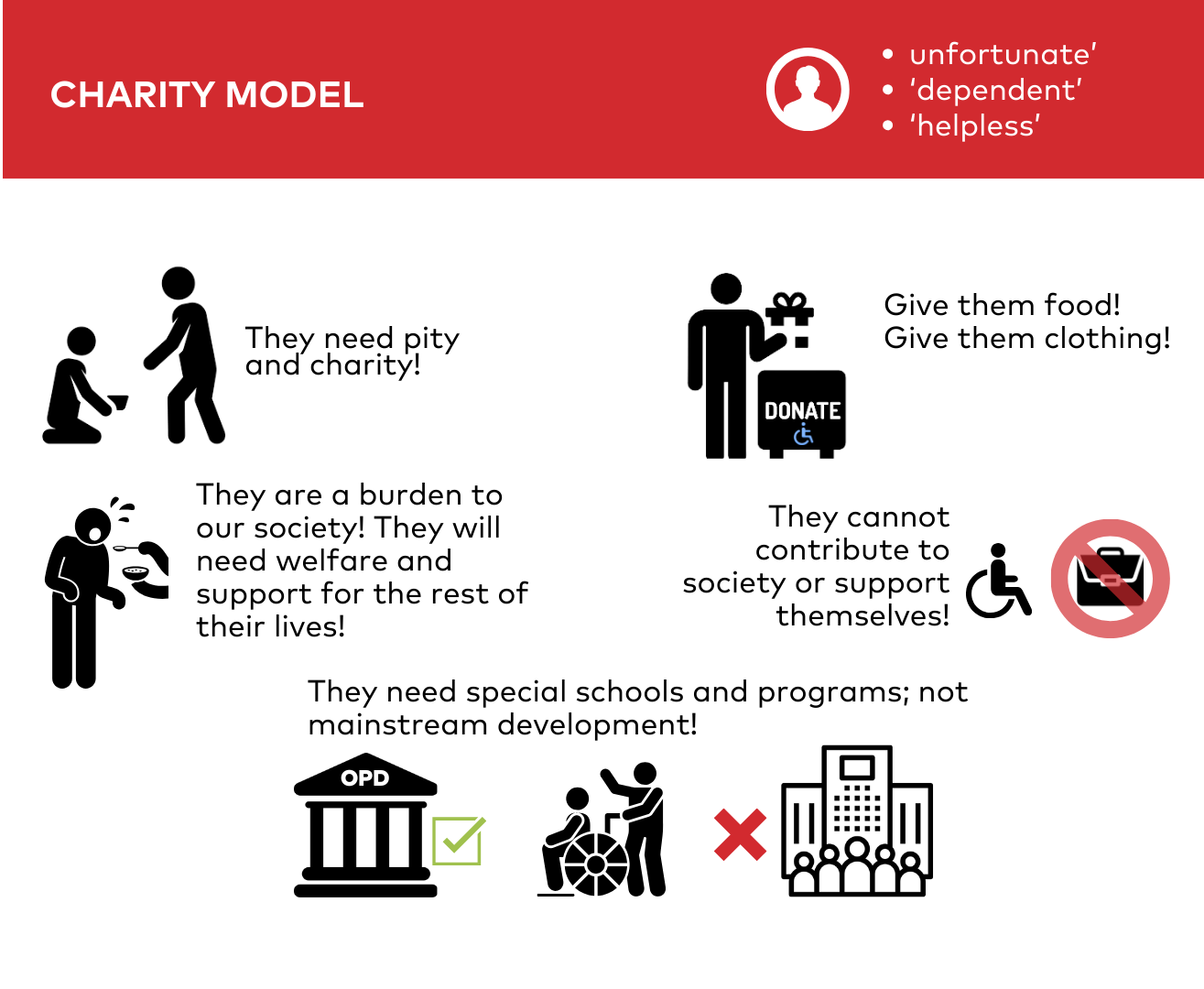
The Charity Approach views persons with disabilities as people in need of “help”. Activities developed through this frame of thinking aim to provide that ‘help’ and often consider persons with disabilities as ‘needy’ or ‘helpless’ and outside of ‘normal’ society.
Some of the core components of this viewpoint include:
- Viewing disability as a problem in the person. People with disabilities are seen as ‘unfortunate’, ‘dependent’ or ‘helpless’; and generally regarded as people who need pity and charity.
- The charity model assumes that people with disabilities cannot contribute to society or support themselves; efforts and activities work mainly towards providing them with money or gifts, such as food or clothing.
- In this model, people with disabilities become long-term recipients of welfare and support; as well as aid provided by specialist organisations, but never included in mainstream development.
- People with disabilities are viewed as a separate group away from the rest of society, to be treated differently.
Self Reflection:
When you encounter a person with disabilities on the street, what first comes to your mind? Do you feel sorry for them and feel like you should help?
When your answer is yes, you are not alone…
The Charity Approach has taught us as a society that we should feel this way. Congratulations! Recognizing that you are having these thoughts is the first step towards changing the way the world views disability. This is not to say that giving charity is wrong. It is sometimes needed. Assuming that a person needs charity because they have a disability is what contributes to othering in society.
By tackling these preconceived notions, you are starting to make a difference!
Medical Approach
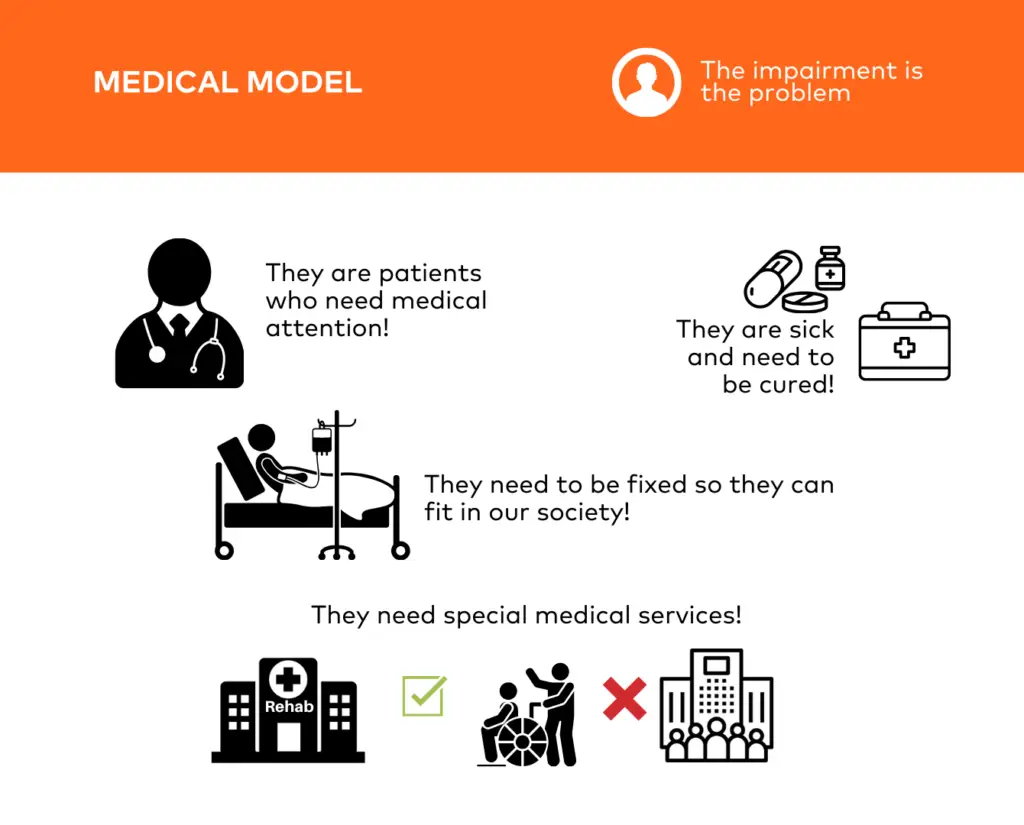
The Medical Approach to viewing disability views persons with disabilities as in need of medical attention. Activities developed through this frame of thinking aim to ‘fix’ person with disabilities, who are ‘sick’, so they can join ‘normal’ society.
Some of the core components of this viewpoint include:
- Seeing disability as a problem in the person
- Focusing on a person’s impairment as the obstacle to their full participation in society and seeks to ‘cure’ or ‘improve’ individuals to ‘fit’ them into society.
- The medical model defines people with disabilities only as a patient with medical needs; and as such, still segregates people with disabilities from the mainstream.
- Only medical help is offered, carried out by specialists.
- This is a generally expensive approach, that tends to benefit a relatively smaller number of people with disabilities.
Self Reflection:
When you have met a person with disabilities in the past, did you find yourself wondering if a surgery or medical procedure would make their life easier?
Lots of people in the world have these thoughts.
The Medical Approach has taught us as a society that ‘fixing’ the disability is the best way to help them to fully participate. But what if medical intervention wasn’t the only way? Viewing disability in this way limits our creativity when it comes to inclusion and can make us feel helpless and sad when we realize that all things can not be ‘cured’. This thinking can keep us stuck in a loop that still causes othering of the disability community. Medical interventions can certainly benefit some people and even prevent long term disability, but what would happen if we all started thinking outside of this box? How could that benefit society as a whole? Congratulations, you have taken step number two towards becoming an inclusion champion!
Social Or Rights-Based Model: Inclusive Approach
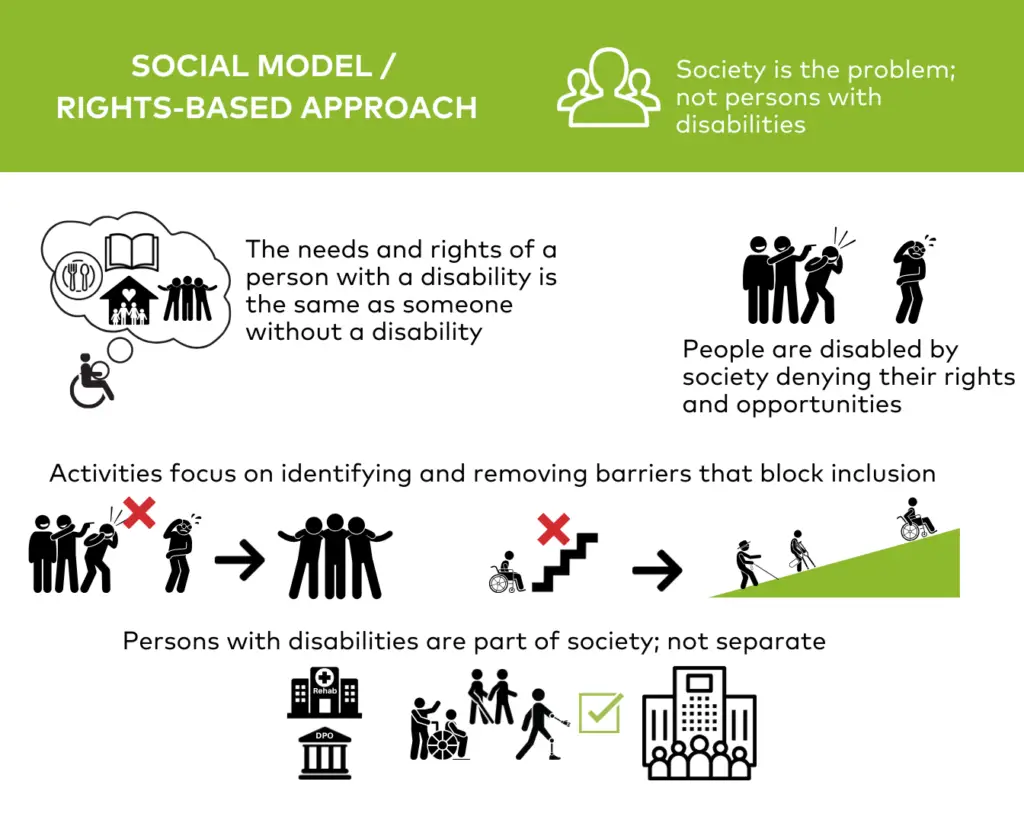
The Social or Rights-Based approach sees society as the greatest barrier to inclusion. Activities developed through this frame of thinking aim to address barriers in society so that people with disabilities are able to fully participate in all aspects of community life.
Some of the core components of this viewpoint include:
- A shift in focus to inclusion of people with disabilities within mainstream society, rather than separate.
Systems, policies, processes and attitudes in society are recognised as the problem to be fixed, adapted and changed, not persons with disabilities. - The model argues that people are disabled by society denying their rights and opportunities, and sees disability as the social consequences of having an impairment or functional limitation.
- The model recognizes that the rights of persons with disabilities such as rights to education, life and opportunities and their needs such as the need for belonging, community and love, are the same as people without disabilities.
- The model emphasizes that activities should focus on identifying and removing attitudinal, environmental and institutional barriers that block inclusion.
Self Reflection:
Has there ever been a time when you have removed a barrier for someone to make sure they could participate in something, no matter how small? How does learning about this model of viewing disability make you feel?
Changing society is a huge task! If you are feeling overwhelmed, that is ok, because there is a lot of work to do.
Lets break this down a bit more so that it feels more manageable.
The Social Approach to understanding disability can be empowering to us all! It is empowering to persons with disabilities because under this model, their rights agency and voice are recognized and they are not seen as an ‘other’ because of their disabilities. It is empowering to people without disabilities because it enables them to see how they can be a part of the solution to inclusion.
Social change is made by taking many small actions that feed into the larger goal. Working to remove any barrier for persons with disabilities is a part of that. Learning about these barriers is a great first step to putting inclusion into action!
Join the discussion on this topic
No topics were found here
- 7 Forums
- 15 Topics
- 19 Posts
- 0 Online
- 24 Members